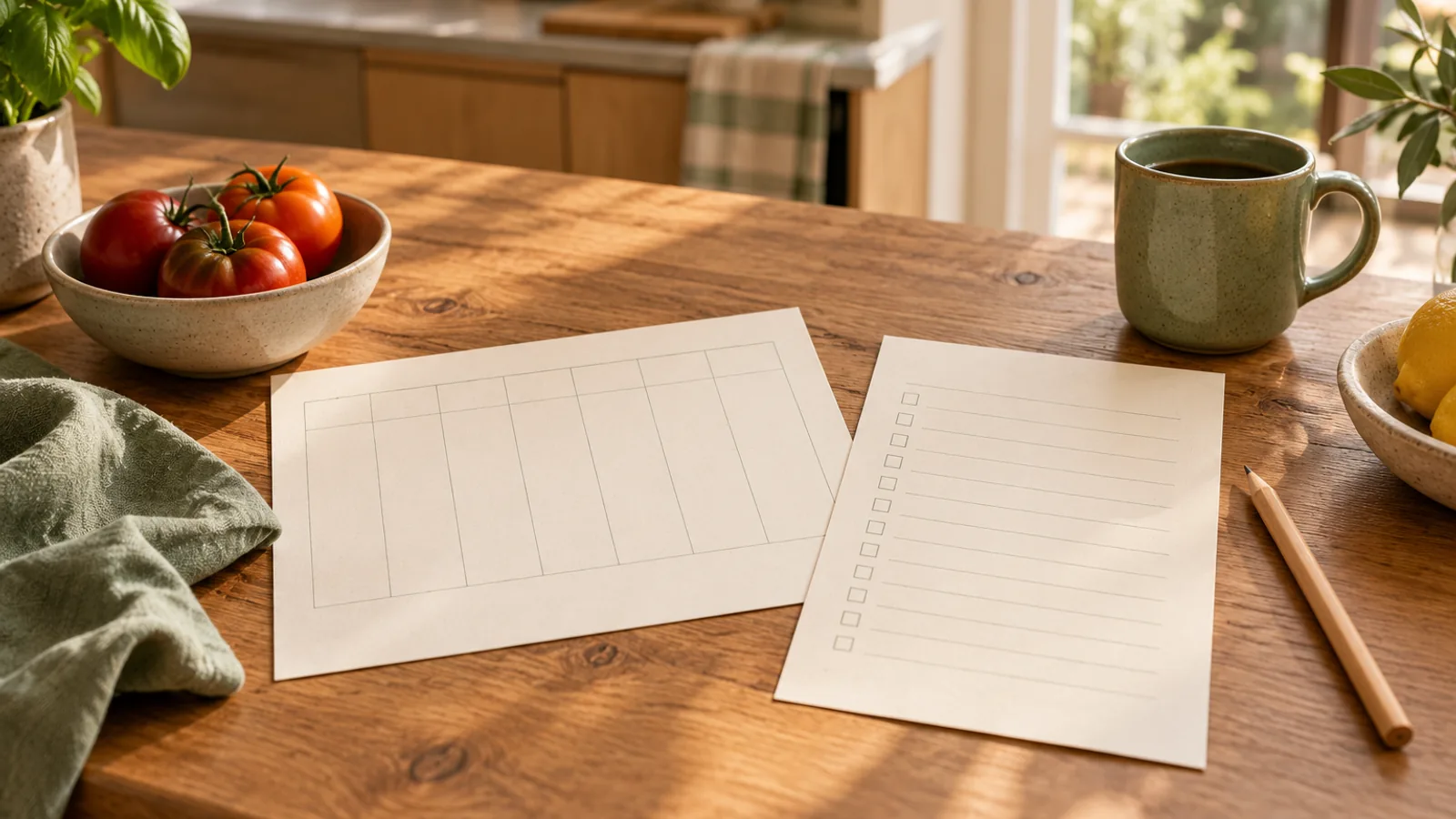
Free Weekly Meal Planner Template with Grocery List
Free printable weekly meal planner template with grocery list. Check the pantry first, plan the week in 20 minutes and buy only what's missing.
Download the free weekly meal planner template with grocery list as a two-page PDF, or open the printable page and type into it before you print. It is free for personal use, needs no sign-up, and is sized for A4 with margins that also suit US Letter paper.
Page 1 plans the week: a seven-day grid for breakfast, lunch, dinner and snacks, a column for leftovers, eating out and skipped meals, and a "Check the pantry first" box. Page 2 is a grocery list template grouped by category, with quantities, "Have it?" tick boxes, the meals each item covers and a budget line.
What's in the weekly meal planner template
Both pages use plain line work with light shading and no images, so they print cleanly in black and white on a home printer.
- Week grid: Monday to Sunday, with a space for the date and columns for breakfast, lunch, dinner and snacks.
- Leftovers, eat out or skip: three tick boxes for each day, for meals that need no cooking and no shopping.
- Check the pantry first: a short table for food to use up, its date and the meal it is planned for.
- Notes: busy nights, guests, swaps and anything to prepare ahead.
- Grocery list: produce, meat and seafood, dairy and eggs, bakery, pantry staples, frozen, household and other, each with quantity, "Have it?", planned meals and estimated cost.
- Budget line: your budget, the estimated total, the actual spend and the difference.
The "Planned meals this covers" column is the part most printable meal planners leave out. When Wednesday's dinner falls through, you can see which items it was going to use and decide whether you still need them.
How to fill in the meal planner in 20 minutes
Set aside about 20 minutes on the same day each week, a day or two before you shop. The times below are a guide; the order matters more than the minutes.
- Check the pantry first (5 minutes). Look in the fridge, freezer and cupboard. Write anything that needs using up in the box on page 1, with its date.
- Mark the week's realities (3 minutes). Note late nights, sport, guests and meals away. Tick leftovers, eat out or skip for those meals so they don't create shopping.
- Plan around what expires first (5 minutes). Put the most perishable food into the earliest suitable meal, then fill the remaining dinners. Breakfasts and lunches can repeat, so write "usual" where they do.
- Turn the meals into a list (5 minutes). Work through the grid one meal at a time. Write each ingredient under its category with the quantity and the meal it covers. If an item appears twice, add to the existing line rather than starting a new one.
- Tick what you already have (2 minutes). Check each line against the fridge and cupboard, tick "Have it?" and leave it off the trolley. Add estimated prices for the rest and compare the total with your budget.
The NSW Government's Love Food Hate Waste shopping advice recommends the same order: do a stock take of the fridge and pantry, plan meals, then write a list that matches the plan. Some people photograph the fridge so they can check it in the shop.
When you write a date in the pantry box, note which kind it is. Food Standards Australia New Zealand explains that use-by dates are about safety, while best-before dates are about quality. Plan use-by food first, and don't eat it after its use-by date.
A worked example week
Here is how one week could look for two adults. The pantry check found half a bag of spinach (use by Tuesday), four eggs, a tin of chickpeas, 500 g of dry pasta and a bag of frozen peas. Thursday is dinner with friends. These are planning examples, not tested recipes, so check the ingredients and quantities in the recipes you use.
| Day | Dinner | Lunch | Leftovers / eat out / skip | Uses up |
|---|---|---|---|---|
| Mon | Spinach and cheese omelettes with toast | Sandwiches | None | Spinach, eggs |
| Tue | Chickpea and vegetable curry with rice (4 portions) | Sandwiches | None | Chickpeas |
| Wed | Pasta with peas, lemon and parmesan | Tuesday's curry | Leftovers (lunch) | Pasta, frozen peas |
| Thu | Dinner with friends | Sandwiches | Eat out (dinner) | None |
| Fri | Chicken and vegetable tray bake (4 portions) | Sandwiches | None | None |
| Sat | Wrap pizzas | Friday's tray bake | Leftovers (lunch) | None |
| Sun | Vegetable soup with bread | Late brunch instead | Skip (lunch) | Remaining carrots and celery |
Turning the grid into a list gives lines like these. Each line names the meals it is for, and the "Have it?" check removes what the pantry already covers.
| Category | Item and quantity | Planned meals this covers | Have it? |
|---|---|---|---|
| Produce | Onions, 3 | Tue curry, Fri tray bake, Sun soup | 1 at home: buy 2 |
| Produce | Carrots, 5 | Fri tray bake, Sun soup | No: buy 5 |
| Meat & seafood | Chicken thighs, 1 kg | Fri tray bake, Sat lunch | No: buy |
| Dairy & eggs | Eggs, 6 | Mon omelettes | 4 at home: buy a pack of 6, 4 left over |
| Pantry staples | Chickpeas, 2 tins | Tue curry | 1 at home: buy 1 |
| Pantry staples | Dry pasta, 300 g | Wed pasta | Yes, 500 g: don't buy |
| Frozen | Peas, 200 g | Wed pasta | Yes: don't buy |
| Bakery | Wraps, 1 pack | Sat wrap pizzas | No: buy |
Thursday's dinner out, Sunday's skipped lunch and the two leftover lunches add nothing to the list. The four spare eggs go straight into next week's "Check the pantry first" box. Store the extra curry and tray-bake portions in the fridge promptly and follow safe leftover guidance.
Tips for families, one person and tight budgets
Families
Write how many people are eating each day in the notes. Plan quick dinners for sport and late-work nights, and keep one flexible meal near the end of the week for leftovers or a freezer option. If someone has an allergy or a different diet, note it beside the grocery line so the substitute isn't forgotten. When two adults share the shopping, agree who owns the list; the shared grocery list guide covers the handoff.
One person
Plan portions rather than recipes. A dinner that makes two portions can fill a lunch slot, so tick "Leftovers" and note where the second portion goes. Pack sizes cause most waste when you cook alone, so give every opened ingredient a second meal before you buy it. The meal plan for one has a worked portion example and its own worksheet.
Tight budgets
Set the budget before you plan, not after you shop. Write estimated prices as you build the list, and if the total runs over, swap one dinner for a cheaper meal built from pantry stock. Reusing a few ingredients across several meals also lets you buy larger packs without waste. The budget meal-planning guide goes further on comparing pack sizes and prices.
When to switch from a printable meal planner to an app
Paper works well when one person plans and shops once a week. It starts to strain when the plan changes mid-week, when more than one person shops, or when you want the list to remember what is already at home. Each change then means rewriting both pages and checking the cupboard again.
An app can carry the same plan. In Kivella's meal planner with grocery list, each day has breakfast, lunch, dinner and snack slots, and a slot can hold a recipe, leftovers, eating out or a skip. Kivella scales each planned recipe to its servings, subtracts the pantry stock you have recorded across the whole week, and shows only the shortfall for you to review before it goes on the shopping list. Meal planning and the shopping list are part of the free plan. Sharing the pantry, plan and list with your household needs Kivella Pro and covers up to five people.
The trade-off is upkeep. The subtraction is only as good as the pantry record you keep, and Kivella runs on iPhone and Android, not in a web browser. If paper suits you, keep using the template; the pantry-aware planning workflow shows the same subtraction by hand.
Frequently asked questions
How do I make a weekly meal plan with a grocery list?
Check what needs using up first, then plan meals around it. Mark the meals you won't cook, write each remaining meal's ingredients under a grocery category with the meal they're for, and tick off what you already have. What's left is your shopping list.
Is this meal planner free to print?
Yes. The PDF and the printable page are free for personal use, with no sign-up or email address required. Print a fresh copy each week, or slip one into a plastic sleeve and reuse it with a whiteboard marker.
Can I edit the template?
Yes, before you print. The printable page lets you type into every box, then print it or save it as a PDF. What you type isn't saved, so print when you're done. The PDF version is designed to be filled in by hand.
What should a grocery list template include?
At a minimum: items grouped by store section, a quantity for each, and a way to mark what you already have. A more useful template also records which meal each item is for, an estimated price and a budget, so you can drop items when plans change and see the total before you shop.
Should I plan every meal or just dinners?
Start with dinners, because they usually use the most fresh ingredients. Add lunches when they come from leftovers or need shopping, and write "usual" for breakfasts that rarely change. The grid has room for every meal, but blank boxes are fine.
Share this insight
Kivella Editorial Team
Kivella's editorial team documents practical pantry, recipe, meal-planning and nutrition workflows. Material claims are checked against primary research or official guidance, and product claims are kept within Kivella's current documented capabilities.
Read our editorial policyShare Article
On this page
Tags
Continue the workflow
Related Kivella guides
Meal planning
Pantry-Aware Meal Planning: From Weekly Plan to Grocery List
Plan realistic meals around what you already own, combine recipe quantities and create one shared grocery list with only the items that are missing.
Meal planning
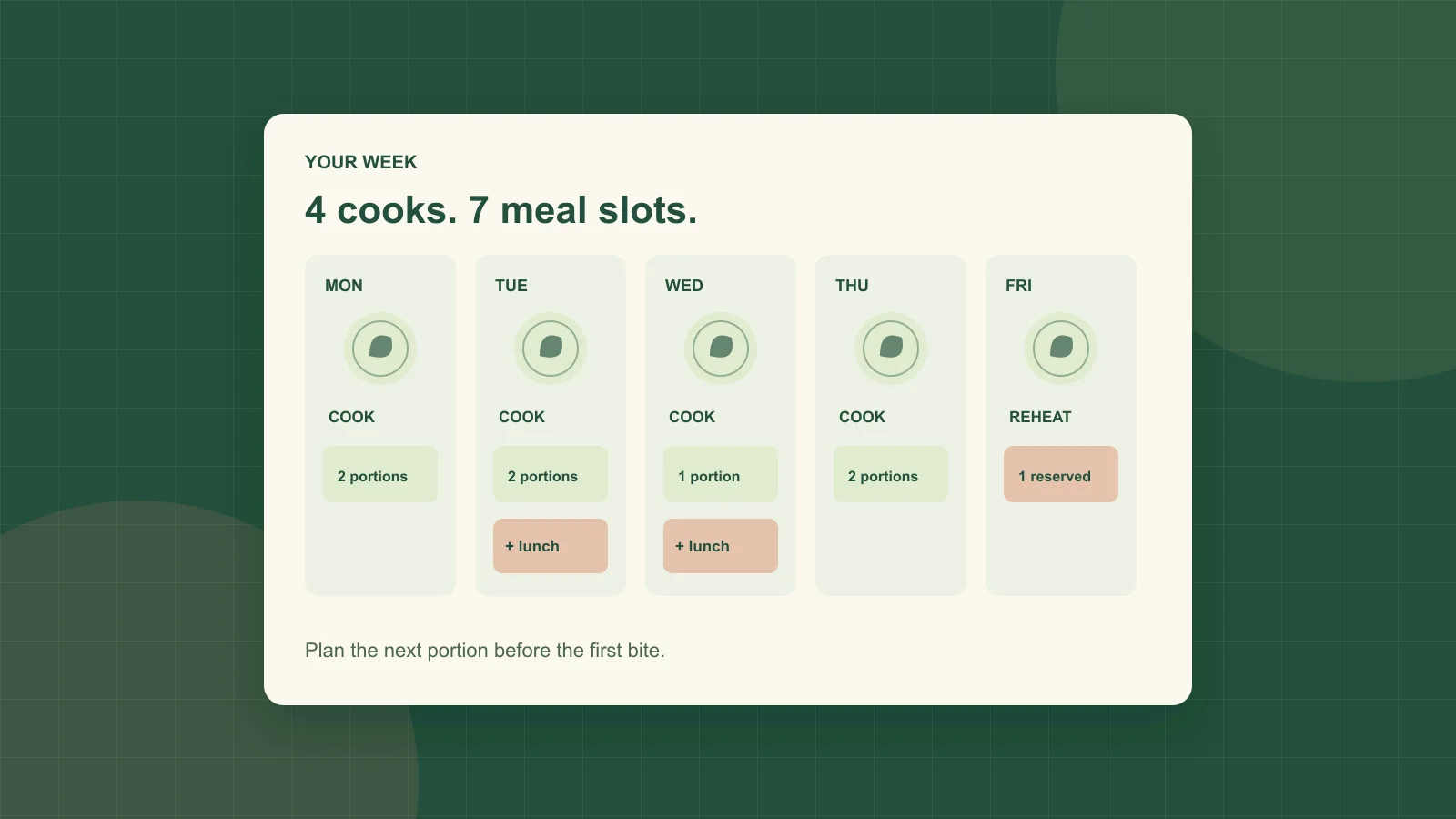
Meal Planning for One: A Weekday Plan and Free Worksheet
Plan five dinners and two lunches without cooking seven separate meals. Includes a portion ledger, ingredient overlap and a free printable worksheet.
Meal planning
Budget Meal Planning: Shop Your Pantry Before the Store
Build a budget meal plan from food you own. Use a worked three-dinner example, compare pack costs and unit prices, and track what you actually spend.