How to Scale a Recipe and Buy the Right Quantities
Convert recipe servings with a simple formula, check units and cooking limits, then subtract pantry stock. Includes examples and a free scaling worksheet.
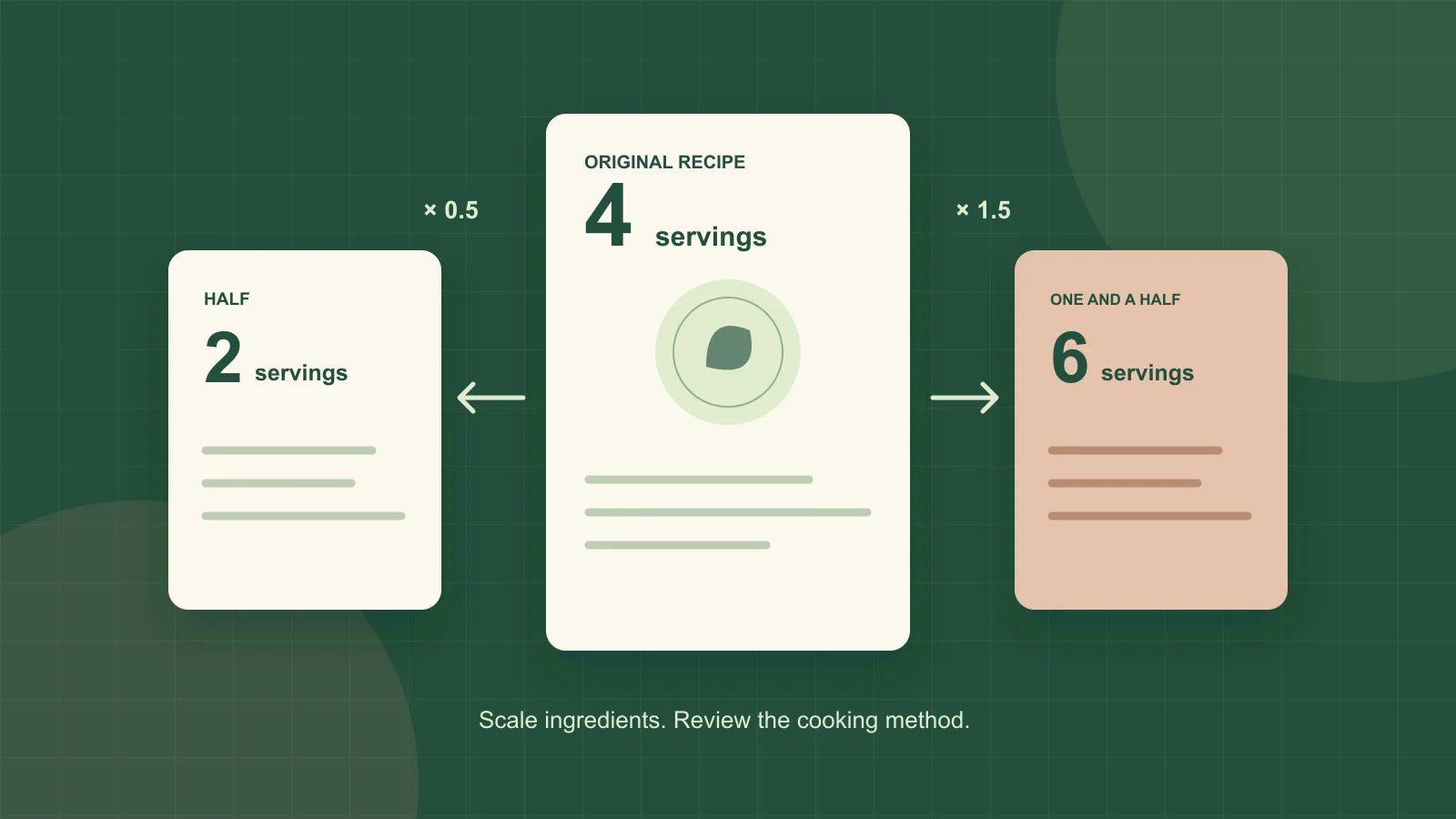
To scale a recipe, divide the number of servings you want by the number the recipe makes. Multiply each measured ingredient quantity by that factor. For a recipe that serves four, use 0.5 to make two servings or 1.5 to make six. To apply the factor to a whole ingredient list at once, paste it into our free recipe scaler.
That calculation changes the ingredient quantities. It does not automatically determine the correct pan, cooking time or amount to buy. A useful conversion has three stages: scale the recipe, check the cooking method, then subtract usable ingredients you already have.
Calculate the serving factor once
Check the source yield before doing any arithmetic. “Makes twelve muffins” and “serves six” are different ways of describing the output. Use the same kind of unit on both sides of the calculation: muffins to muffins or servings to servings.
| Original yield | Desired yield | Multiply ingredients by |
|---|---|---|
| 4 servings | 1 serving | 0.25 |
| 4 servings | 2 servings | 0.5 |
| 4 servings | 6 servings | 1.5 |
| 6 servings | 4 servings | 2/3 |
| 12 muffins | 18 muffins | 1.5 |
Keep enough precision while calculating. For six servings reduced to four, use 2/3 rather than rounding to 0.7 before multiplying every line. Round the final amount only when you know how you will measure it.
The Australian Nutrition Foundation's Queensland division explains this proportional approach in its Scaling Recipes factsheet. It also highlights cooking time, temperature and equipment size as separate considerations. The numbers below are original arithmetic examples, not a tested recipe.
Work through the whole ingredient list before cooking
Here is an illustrative pasta ingredient list scaled from four portions to two and six. The purpose is to show consistent conversion, so use the method and seasonings from your own complete recipe.
| Ingredient | 4 servings | 2 servings × 0.5 | 6 servings × 1.5 |
|---|---|---|---|
| Dry pasta | 300 g | 150 g | 450 g |
| Chopped tomatoes | 400 g | 200 g | 600 g |
| Frozen peas | 200 g | 100 g | 300 g |
| Spinach | 160 g | 80 g | 240 g |
| Olive oil | 20 ml | 10 ml | 30 ml |
Copy the converted quantities into one cooking view before you start. Switching between the original recipe and mental calculations makes it easy to halve the pasta but accidentally add the full amount of sauce.
Keep instructions such as “for greasing” or “to taste” as instructions. They do not contain a measurable quantity to multiply. For a savoury dish, taste and adjust seasoning at an appropriate stage in the method. Do not invent a universal percentage reduction for salt, spices or baking powder.
Keep units and ingredient states consistent
200 g dry rice is not the same entry as 200 g cooked rice. Likewise, a tin's total weight can include liquid that a recipe asks you to drain away. Read the description alongside the number before merging ingredients or checking your pantry.
- Weight and volume: grams measure weight and millilitres measure volume. Do not replace one with the other using a universal one-to-one conversion.
- Whole and prepared food: preserve notes such as peeled, drained, chopped or boneless when they affect the required amount.
- Package counts: convert “one tin” using the actual size and, when relevant, drained weight on the product you intend to use.
- Measuring cups and spoons: use the measurement convention specified by the source recipe. If it is unclear, look for weights supplied by the author.
If the recipe says “one onion” and your new factor is 0.5, half an onion may be a practical savoury-cooking measure. If it specifies 120 g prepared onion, the scaled target is 60 g. Keep the unused portion on your ingredient plan rather than silently using the whole onion and changing the dish.
Check baking, partial eggs and equipment separately
Baking deserves a second review because the amount of batter and its depth affect the result. For a reduced recipe, choose a suitable pan and follow the recipe author's guidance on doneness. Multiplying a forty-minute bake by 0.5 does not establish that the smaller version is ready after twenty minutes.
King Arthur Baking's guide to reducing recipes explains pan-area comparisons, weighing ingredients and dealing with partial eggs. For part of a whole egg, it recommends lightly whisking the egg and weighing the proportion required. If a recipe separately calls for a white or yolk, preserve that distinction.
For example, if your cracked and mixed egg weighs 52 g, half is 26 g. That is a calculation from the egg you measured, not an assumption that every egg has the same weight. Weighing is more reliable than estimating half by looking at a bowl.
For larger stovetop batches, check whether the pan can hold the food at a workable depth. Two batches using familiar equipment may be easier to manage than a single overcrowded pan. Follow appliance capacity limits and the recipe's food-safety instructions. For preserving or canning, use a tested recipe and its explicit batch guidance rather than this general serving calculation.
Turn scaled ingredients into a purchase quantity
Scale all the recipes in your plan first. Then group compatible ingredients, total their requirements and subtract usable stock. Round up to a pack size at the shopping stage, not inside the recipe.
Suppose your scaled pasta dish needs 150 g dry pasta, and another planned dish needs 200 g of the same pasta. The combined requirement is 350 g. You have checked the pantry and found 120 g available. Your shopping shortfall is 350 − 120 = 230 g.
If you buy a 500 g pack, 270 g from that new pack remains after meeting the shortfall. Keep that amount in the pantry record. The recipes still need their original scaled amounts; buying a larger pack does not mean adding the entire pack to dinner.
A recipe manager may help with the calculation, but review extracted fractions, units and serving yields first. A correctly multiplied mistake is still a mistake. Our guide to saving recipes from social videos explains the source checks that come before scaling.
Save a conversion you can use again
Download the recipe scaling CSV worksheet. It contains the worked example with original quantity, unit, desired servings, factor and scaled quantity. The example values are already calculated; it is a worksheet you can edit, not an automatic calculator.
After cooking, record the actual yield, pan, timing and any deliberate changes beside the recipe. Distinguish a personal adjustment from the creator's original version. That makes your saved-recipe collection more useful next time you cook for the same number.
For a small household, use the result in a meal plan for one. For several recipes, continue to the combined grocery-list workflow.
Share this insight
Kivella Editorial Team
Kivella's editorial team documents practical pantry, recipe, meal-planning and nutrition workflows. Material claims are checked against primary research or official guidance, and product claims are kept within Kivella's current documented capabilities.
Read our editorial policyShare Article
On this page
Tags
Continue the workflow
Related Kivella guides
Meal planning
Meal Planning for One: A Weekday Plan and Free Worksheet
Plan five dinners and two lunches without cooking seven separate meals. Includes a portion ledger, ingredient overlap and a free printable worksheet.
Meal planning
Pantry-Aware Meal Planning: From Weekly Plan to Grocery List
Plan realistic meals around what you already own, combine recipe quantities and create one shared grocery list with only the items that are missing.
Recipe organization
How to Organize Recipes So You Can Find Them Again
Turn a crowded recipe collection into a useful dinner library with a retrieval check, simple labels, duplicate rules and a free recipe-index template.